Tuesday, November 29, 2016

Unit 4 Reflection


Why is Sex So Great?

The coin sex lab was done to demonstrate Mendel's Laws of Segregation and Independent Assortment. We first predicted the probability of mono hybrid crosses such as gender and colorblindness. Using Punnet Squares, we predicted that we would get 12 normal vision children and 4 color blind children. We did not get such results. We got around 50% of the 16 children tested were colorblind. For the dihybrid cross we tested, we did not get the predicted results of 9:3:3:1. We got an unlikely 3:8:2:3. This shows that although we can predict the traits of the offspring due to meiosis, we don't always get predicted results. Like in the dihybrid results, we did not get the predicted results, but rather a very outrageous result. An example of the lack of reliance from predicting traits is colorblindness. We predicted that 25% of the offspring would be colorblind, but that number was nearly doubled.

This unit's essential question was 'Why is Sex so Great'. In this lab we learned about mitosis, which is the reproduction of autosomes, and meiosis, which is also cell's reproduction, but only for X-linked cells. We know that our knowledge of biology all roots from Mendel's original studies of pea plants, as he was the one who discovered such important factors such as dominance and probability. Because of his discoveries, we now have knowledge of the complexity of genes, and how there is often may factors affecting each allele, such ass multifactorial disorders, gene linkage, and polygenic traits. Not only do we know of the traits and the chromosomes, but we can predict the outcome of the offspring. We can predict them using punnet squares. Monohybrid crosses are simple punnet squares we are used to seeing with 4 outcomes, 3/4 of which are dominant, and the remaining recessive. However, in a dihybrid cross, there are 16 possible outcomes, with a ratio of 9:3:3:1. This means that there are likely to be 9 totally dominant offspring, with 3 dominant and recessive, respectively, offspring, 3 recessive and dominant offspring, and lastly 1 totally recessive offspring.

This unit was more serious than what I had ever experienced before with sexual reproduction. I had never learned about mitosis and meiosis, but I still have many questions. I would like to learn more about inheritance especially, as that is intriguing to me. I am not so much unsure as I am curious about it because there are so many possibilities in the processes and so much room for error. The human body is extremely complex, as I learn everyday in this class. I have grown in this unit most out of all we have done this year because this unit brought maturity and complex understanding. Such processes as Mitosis and Meiosis cannot be memorized, but must be learned and understood.

Monday, October 31, 2016

Is Sexual Reproduction Important?

Is Sexual Reproduction Important?

In Dr. Tatiana’s Sex Advice To All Creation, Olivia Judson personifies animals, insects, and other organisms to explain and compare sexual and asexual reproduction. Asexual reproduction is common among prokaryotes and some eukaryotes, while sexual reproduction is common among eukaryotes, especially mammals. We read about how Philodina Roseola is an asexual organism. However, she is not just an asexual organism, but she is apart of a population that has asexually reproduced for 85 million years. To add to her already impressive accomplishments, she is one of 360 different species, all rooting from one organism and reproducing asexually. She explains to the audience how she functions and how her family has lived 85 million years without men. Her ancestors before her have ridden their population of men, and Philodina Roseola  had urged the rest of the world to do the same. However, as she continued to talk about asexual reproduction, a ram stepped in a questioned her asexual reproduction. He brought up many different species who had claimed to be asexual for a long period of time, but lied. One of these species, the chaetenotoid gastrotichs. This species lived in puddles and mosses, just like the Philodina Roseola, and claimed to be asexual reproducers. Unfortunately for them, scientists discovered the organisms making sperm, a sexual component, and they were found out to be sexual reproducing organisms. To this, Philodina Roseola brought up substantial evidence proving her abstinence.  
Asexual reproduction, or cloning, is much more efficient, and easier. The mother only has to have one offspring to maintain population, and there is less time and energy involved. Asexual reproduction is very efficient, but it is also dangerous. Sometimes, mutations can develop in a large population constantly cloning themselves. Considering the fact that mutations are usually bad, and affect the organism in a negative way. This is where sexual reproduction has the upper hand. In this type of reproduction, the offspring has a random half of genes from the father, and the other random half from his mother. This ensures a different offspring from the parents, and no transfer of harmful mutations. There are many different theories why asexual reproduction leads to an eventual extinction. The first of the three front-runners is Muller’s Ratchet. This theory states that asexuals are evolutionarily short-lived due to a development of harmful mutations that will “irrevocably and inevitably carry ratchet upward. Imagine a population that has just become asexual...Over time, copying errors will lead to mutations among their descendants, and gradually the population will consist of individuals who carry several mutations...this process continues until all the individuals are so sick that they die and the population goes extinct”. Muller’s theory, fortunately or unfortunately, contains many assumptions. One large assumption is that the population is small to being with. This is where Kondrashov’s hatchet comes in to solve the holes in Muller’s theory. This Russian’s theory is not affected by the size of the population. This theory has a theoretical threshold number of the amount of mutations that any individual can carry. In a population that has sex, the shuffling of genes creates some lucky creatures with a only few harmful mutations. This means that there are some unlucky ones with many mutations. With asexual reproduction, many more organisms will cross the threshold with one to many mutations According to Olivia Judson, who is summarizing this theory, “‘Harmful mutations could be the reason most asexuals go extinct’”.
The last two theories has been based on mutations. The last of the theories, the Red Queen, is based on something entirely different. Parasites. To easier explain this theory to the audience, Olivia Judson tells the story of the Atta colombica. This ant is apart of a 23 million year old species, and they farm fungus in order to eat and survive. These ants are under constant fear of an outbreak of Escovopsis. The ant then explained this as a “virulent disease of the fungus, and if it breaks out, it will destroy the whole garden...Our fungus is also asexual. Not quite as ancient as you, Miss Philodina…We propagate the fungus clonally and when a new queen leaves her natal nest to start her one colony, she takes some cultivars of fungus with her...This means our fungus gardens are like modern human crops: they are monocultures, whole fields that are genetically identical…”. He then told the bacteria at the center of all this that a disease starting somewhere would have a “field day” and destroy the fungus everywhere. This is why sex would be advantageous so fungus with different genes could have an edge over the unevolved disease. The Red Queen theory states that since asexuals keep the same genes from one generation to another generation, parasites can easily evolve to infiltrate their defenses, annihilating clones. However, ses, by mixing up genes, prevents parasites from becoming too well adapted to their hosts. “Sex is an advantage because it breaks up gene combinations…”.
This passage was quite confusing in some areas, mostly due to the vocabulary and the writing format of personifying animals. I would like to learn more about things such as the armadillo, and other living organisms that use both sexual and asexual reproduction.

Thursday, October 27, 2016

Unit 3 Reflection


In this unit, we learned about the cell. This was our first step into actual biology.

The cell theory states that 1. All living things are made up of cells. 2. The cell is the most basic unit of life. 3. New cells are generated from existing cells. In the 1600s, Zacharias Jansen and Anton von Leeuwanhok created the first microscopes. This lead Robert Hooke to give the cell its name. It also lead Mattias Schleiden to realize all plants are made up of cells, while Theodore Schwann made the same observation for animal cells. The invention of the microscope also lead to the discovery of different types of cells: the prokaryote, and the eukaryote.

Cell membranes give the cell its structure and support the cell. The membrane is made of a lipid bilayer, which also has embedded protein molecules inside. These proteins have carbohydrate molecules sticking to them. The cell membrane's function is to keep things out of the cell, to keep things in the cell, and to choose what enters and what exits the cell. For the cell membrane to complete its tasks, it must be semi-permeable, or ability to let certain things pass through but other things cannot. There are 7 membranes in a eukaryotic cell: the nuclear membrane, the lysosome, the endoplasmic reticulum, the vesicle, the golgi apparatus, the membrane in chloroplasts and mitochondria, and lastly, the cell membrane. Diffusion is the movement of very small molecules from high concentration to low concentration through a lipid bilayer. There is passive transport, which is trasportation without energy or effort from the cell, and there is active transport, which is transportation with the cell's energy required. Active transport is completed using the membranes transport proteins, and is used only when there are highly needed molecules/things by the cell, or when the cell is going against the concentration gradient. Osmosis is the diffusion of water through a semipermeable membrane. Water is a universal solvent, and solvents are small enough to pass through membranes while solutes are not. This means when there is a solution with uneven concentration, the solvent either leaves or enters the cell in various amounts until equilibrium is achieved. An isotonic solution is when the solution inside the cell has the same concentration than that outside the cell. A hypotonic solution is when the concentration of the solution outside the cell is more diluted than that inside the cell. Because of this, water goes into the cell, causing the cell to gain water and size. A hyptertonic solution is the complete opposite of this and the cell loses both water and size.

Our next important topic is how to cell makes proteins. First of all, the nucleus holds both the DNA and the genes, or specific instructions to make the proteins. The nucleus sends the genes to the ribosomes, or the assembly line. After the proteins have started being made, they are put into the endoplasmic reticulum to be finished. After this, the golgi apparatus takes control and finishes it. From the golgi apparatus, vesicles take the protein out of the cell to where ever the protein is needed.
We then talked about the evolution of the cell. When Earth was still developing and when there was very little oxygen in the atmosphere, simple prokaryotic cells were the only things that ruled the earth. These prokaryotes broke down what little oxygen there was. However, cyanobacteria evolved and started photosynthesis. They could break down oxygen and water. This lead to more oxygen being produced and thrown into the air. This changed the world, which started to lead to more change. Some heterotrophs began eating other cells, Fortunately, not all the cells were digested, and were still living in the heterotroph. The cells started to live in symbiosis, which then lead to the endosymbiotic, which is the theory that explains how a large cell ingested bacteria and became part of it. Over millions of years, chloroplasts and mitochondria have become more specialized and now cannot survive on their own.

Photosynthesis is a plants way of converting light and carbon dioxide into glucose, or food. First of all, autotorphs absorb their energy from red and blue light. Chloroplasts are organelles containing stroma and grana. the grana are stacks of thylakoids. the light dependent reaction is when the light is absorbed and energy is transferred between molecules via the electron transport chain. this produces NADPH and ATP. The light independent reaction produces sugar from carbon dioxide using ATP and NADPH from light reactions. The calvin cycle is the light independent reaction, and it rotates 6 times to produce 1 glucose molecule.

Cellular respiration is the process of cells breaking down the glucose made by photosynthesis into energy. Cellular respiration produces 36 ATP for each glucose molecule in 3 steps. First is glycolysis.  This occurs in the cytoplasm. 2 ATP is produced for every one glucose molecule. Then the Krebs Cycle converts the molecules from glycolysis into 2 ATP, 6 carbon dioxide, and NADH and FADH2. Lastly, the electron transport chain occurs within the inner membrane of the mitochondria. This uses oxygen, NADH, and FADH2 to convert ADP to ATP. The electron transport chain used the oxygen breathed in to recharge ADP to ATP. This last part creates 32 ATP. This means that in total, cellular respiration produces 36 ATP, 6 carbon dioxide, and 6 water molecules in total per 1 glucose molecule to start with.

Tuesday, October 11, 2016

Egg Diffusion Lab

Egg Diffusion Lab


There was a negative change in the mass and the weight of the egg. The egg mass changed by an average of -46.09%, while the circumference changed an average of -22.11%. There was more water inside the egg than outside, so this became a hypertonic solution. This caused the water to leave the egg and diluting the corn syrup. The lack of water in the egg caused it to lose mass and circumference. Cells achieve equilibrium between the solvent and the solute. Because the solute, corn syrup, is too large to diffuse into the egg membrane and equalize, the solvent, water, diffused out of the egg to dilute the solvent. 

The cell's internal environment changes so that it can adapt and function with the outside environment. It changes with the concentration gradient and achieving equilibrium. This means the solvent in and out of the cell diffuses in and out of the cell through the membrane so that the solution will become isotonic. In this lab, water was the solvent. When we put the egg in vinegar, it grew because vinegar is mostly water. This caused the water of the vinegar to diffuse into the cell so that there would be equal amounts both in and out of the cell. However, once we put the egg in the sugar water, most of the water diffused out of it into the corn syrup. This is because the corn syrup has very little water and the egg let it all go to dilute the sugar water solution. This caused the egg to shrivel up and lose mass and circumference. Just like the vinegar, once we put the egg in deionized water, it gained a lot of circumference and mass because there was a high concentration of water outside, which caused the water to diffuse into the cell.

This experiment shows homeostasis. Homeostasis is the cell's ability to maintain internal conditions despite changing external conditions. The egg, which represented the cell, diffused water into or out of itself to maintain internal conditions.

Fresh vegetables are sprinkled with water at the market so that they don't lose their color and look. If dehydrated, the plants will shrivel up, look unattractive, and die sooner than normal. Roads are salted to melt ice to dehydrate the roadside plants. Dehydration occurs because there is now more salt outside the plant cells than inside, which causes the water that was originally in the cell to diffuse into the salt, making a salt water solution. Because the original water is now mixed with salt, the cell diffuses the road water into the cells. This diffusion process causes the ice from the road to melt away and go to the plants.

Based on this experiment, I would want to test what would happen to an egg if covered in salt and put in a humid room. I would want to test whether or not the egg would diffuse the water from the air in a gaseous state into itself. I would also want to test what would happen if we put an egg in a solute. Not a solute solution, but a solid solute like on a large block of salt.


Monday, October 10, 2016

Egg Macromolecules Lab

Egg Macromolecules Lab

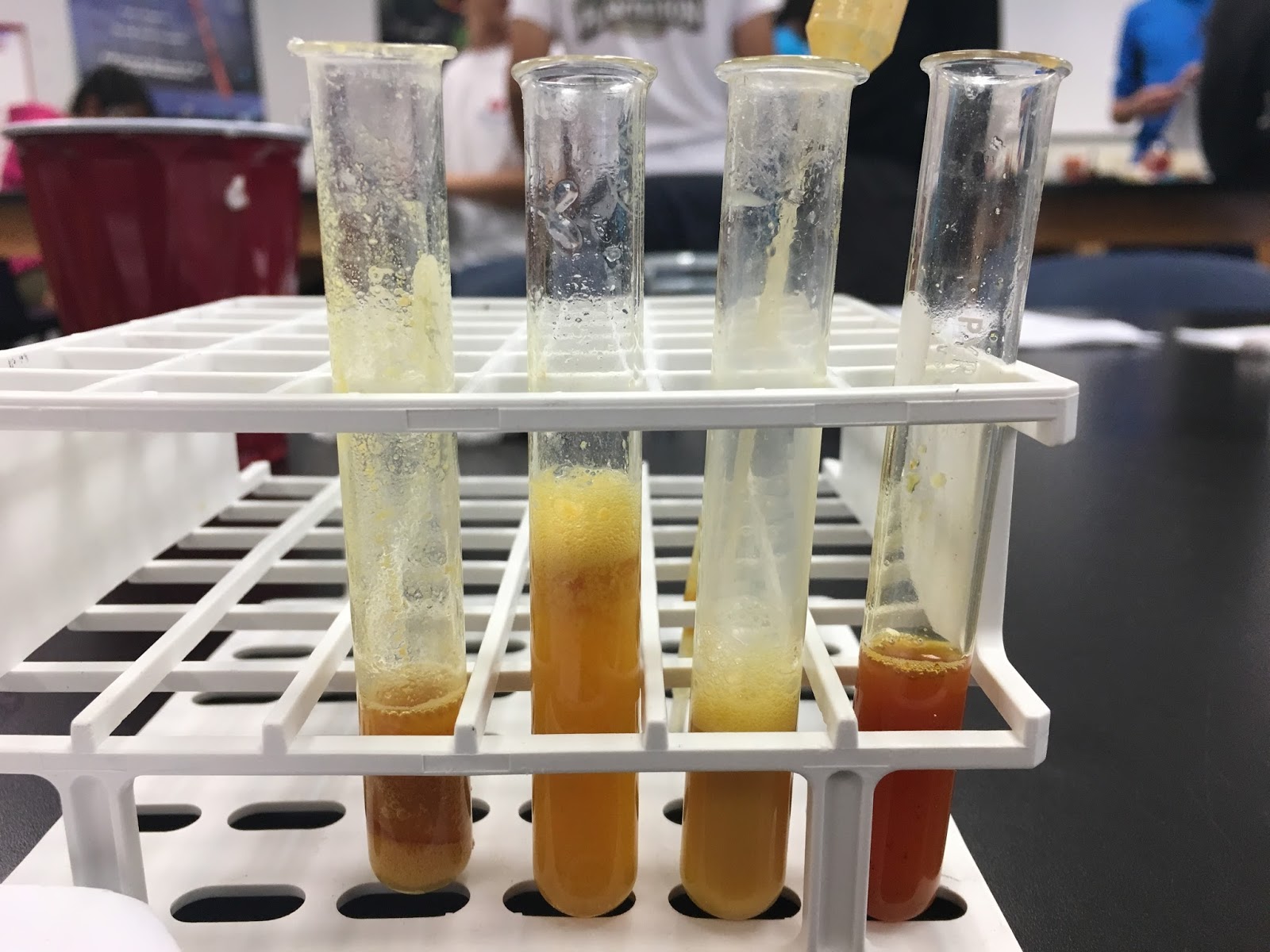
In this lab we asked the question "Can macromolecules be identified in an egg cell?" We found out that of the four macromolecules,  proteins were in all of the egg parts, the egg yolk, the egg membrane, and the egg white. The egg membrane would have the protein as the most present macromolecule, with quantitative data of 3 out of 10. We know the egg membrane contains protein because the membrane itself changed from its original color to purple. This was a reaction with the sodium hydroxide. The evidence supports our reasoning because the egg is a cell. The cell membrane includes proteins. We also know the evidence supports our reasoning because the membrane turned purple. We know the egg white contains protein because it also turned purple when mixed with the sodium hydroxide. We also rated this one at a 3 out of 10 on the amount of protein it contained.We know there are proteins in the egg white because the egg white is the cytoplasm of the egg. The enzymes in the egg are in the cytoplasm, which would have lead to the white turning purple. The evidence supports our reasoning because the solution turned from white to purple when mixed with sodium hydroxide. Lastly, the egg yolk also turned purple with the sodium hydroxide. It had the quantitative result of 8 out of 10. This evidence supports our reasoning because the yolk turned purple, signaling that there are proteins in the yolk, and also because of the fact that the egg yolk is where the chicken is made. The yolk contains all the structural proteins. This data supports our claim because out of all the macromolecules, protein was the most present in all three parts of the cell.
While our hypothesis was supported by our date, there could have been errors due to measurement errors, We may have added too much or too little of the sodium hydroxide or other mixing liquid. This may have caused the part of the egg we were testing to change into another shade of the positive color. If we added too little, then it may have been to light for us to see the real color change. If we added too much, then the color may have been too dark for us to tell, or for us to see it as a different color.  Another error could have been cross contamination. Our egg for this experiment burst as we were pouring it into the cup. this could have caused the membrane of the egg yolk to break and to mix with the other parts of the egg. Another possibility is that the egg membrane was covered in the egg white, which could have changed the results because different amounts of macromolecules are found in different parts of the cell. Due to the errors, in future experiments we could boil the egg instead of put it in vinegar. This would lead to an easier separation of the membrane from the egg white, and also would lead to easier testing of each egg component. All three components could be easily picked up by forceps, and tested. This would decrease risk of cross contamination and be more hygienic. To solve the first error of color observation, we could look at our solutions under a microscope to observe the color change. This will decrease the risk of misinterpreting the color, and will specify whether or not the component of the egg has the macromolecule.

We did this lab because the egg represented a cell in the body. We did this lab to show the presence of all four macromolecules. We also demonstrated which macromolecules were most present. From this lab I learned about the components of the cell and how to identify macromolecules in food and different cells. Based on my experience from this lab, I can now identify macromolecules in foods, and also observe possible things that are cells, like eggs.


Monday, September 26, 2016

Unit 2 Reflection

Unit 2 was was Miniature Biology. This is because it focused on the smaller parts of life. It focused on macromolecules, molecules, compounds, elements, atoms, and subatomic particles. We learned about three of the four types of bonds. The Ionic Bonds forms when an atom gains or looses and electron. The Covalent Bond forms when electrons are shared between atoms. Lastly, there is the Hydrogen Bonds. These bonds are not as strong as the other bonds, but it holds molecules together due to the slight attraction of positive to negative charged regions. Next, we focused on water and polarity. We learned that water is wet because of its polarity, and capillary action. Polarity is the unequal distribution of charge between Hydrogen and Oxygen. Capillary Action is when cohesion and adhesion work together and causes water to rise up vs. the force of gravity. pH is a measurement of H+ ions in a solution. H+ is a hydrogen ion. Acids, ph less than 7, tastes sour, is corrosive to metals, become less acidic when mixed with bases, and is also attracted to bases.
Bases on the other hand, have ph level more than 7, taste bitter, feel slippery, and become less basic when mixed with acids. As with acids attracted to bases, the bases are attracted to acids.

Next, we talked about the 4 macromolecules, carbohydrates, lipids, proteins, and nucleic acids. Carbohydrates are sugars, or saccharides. They have rings with the structure of C (carbon) H (hydrogen) and O (oxygen). There are 3 types of carbs: monosaccharides, disaccharides, and polysaccharides. Monosaccharides have only one ring of structure. The disaccharides have 2 rings, while the polysaccharides have 3+ rings. Carbohydrates are the main source of energy for living organisms like us who consume carbohydrates.

Lipids are large molecules that include fats, phospholipids, oils, waxes, and cholesterol. They have the structure that contain long chains of carbon and hydrogen called fatty acid. Most lipids are nonpolar, or uncharged. Many lipids also have a hydropholic, water loving, head that faces outwards and a hydrophobic, water fearing, tail that faces inwards. Lipids are used as energy storage, and break bonds between carbon and hydrogen to get energy when glucose is running low. They also make up the cell membrane and are used to make hormones. There are saturated fats, bad for you, and unsaturated fats, good for you.

Proteins are large molecules made up of smaller molecules called amino acids, that are chained together. We make the protein we use in our body by eating proteins, and then the body breaks down the protein into amino acids. Amino acids are then recycled into new proteins. Proteins support the body, help cells communicate, let things pass through the cell membrane, and speed up chemical reactions. The 4 types of proteins are hemoglobin, collagen, muscle proteins, and kerratin. Enzymes make chemical reactions happen. They either break molecules apart or they put them together. The substrate is what the enzyme works on, while the active sight is where the substrate attaches to the enzyme. The product is what the enzyme produces.

Nucleic acids, the last of the 4 macromolecules, are large molecules composed of up to thousands of repeating nucleotides. Nucleotides are made up of a sugar, a phosphate, and a nitrogen molecule.
DNA and RNA are nucleic acids, and DNA has two strands while RNA has only one strand. Nucleic acids are the sources of information passed from generation to generation.

Enzymes are made up of 4 structures: primary structure, secondary structure, tertiary structure, and quaternary structure. pH and temperature are the two factors that affect enzymes. Denaturation is when an enzyme or a protein unwinds and loses its ability to work. Simple denaturation is the denaturation of the tertiary and quaternary structures while completely denatured is when the primary structure is denatured.

In this unit, I learned a lot about the smaller parts of our body. I knew organisms were made of atoms, and molecules, but I thought we only used the macromolecules as energy and they had no real body effects. I learned about how the macromolecules are important to the body and how they are apart of all of our body. I also learned about how water sticks to itself and how it can go against gravity. Before this, I did not realize water sticking together as droplets. I just noticed it. I did not think about it until now. One thing I would like to continue to learn about is water. I would like to learn more about its properties, and how it can be changed. I would also like to learn more about polar and nonpolar liquids.

Monday, September 19, 2016

Are all Sugars Really Sweet?


Sweetness Lab

In this lab we asked the question: "How does the structure of the carbohydrate affect its taste(sweetness)?" We found that monosaccharides, the single ringed carbohydrate, was the sweetest tasting, the disaccharides, the double ringed carbohydrate, were moderately sweet, and the polysaccharides, the multiple ringed(3+) carbohydrate, was the least sweet. My data table is shown below. The Sucrose, a monosaccharide, was considered a 200 out of 200, while Maltose, a disaccharide was considered a 10 and Starch, a polysaccharide, was considered a 0. 
Cells/organisms may use carbohydrates with different structures by bonding with different things like other carbohydrates or by using them to fuel/give energy to different parts of the cell/organism. It could also determine how energy is stored. 

Not all testers gave each sample the same rating. Some explanations for this could be that the testers's taste buds were different from each other. Another explanation could be that the testers did not totally rid themselves of the taste of the previous sugar. This could have lead to a mix in tastes giving different results to different testers. Another reason that could have affected the tasting is the amount of sugar tasted. A different amount of sugar could have lead to different sugar concentration. 

Sweetness is received by taste receptors. These taste receptors are clumped together into taste buds. In most organisms like humans or dogs, taste buds are small pegs of epithelium on the tongue called papillae. Taste buds contain from 50-150 taste receptors. 

http://www.vivo.colostate.edu/hbooks/pathphys/digestion/pregastric/taste.html