Wednesday, February 1, 2017

Unit 6 Reflection

In this unit, we focused on biotechnology and bioethics. We first learned about what and where biology/biotechnology is and is used. There are four main areas of biotechnology. The first is Industrial and Environmental. This category is related to taste. The most significant biotechnology part of this is fermentation, or the use of bacteria or yeast in an oxygen free environment, to convert the sugars into acids, gases, and/or alcohol. The next category was Medical and Pharmaceutical. In this category, there is gene therapy. This is putting a healthy copy of a gene into cells of a person whose copy is defective. There are two types of therapy, which are germ line therapy and somatic gene therapy. In agriculture, the third category, there are GMO's and breeding. Agricultural biotechnology is focusing on our foods, or rather where they come from. Both the breeding and genetically modified organisms have an outcome of reproducing the same traits down through generations. In the last category, diagnostic, the main point is genetic testing. This is the search for genes or DNA segments indicating risk for various diseases or disorders.

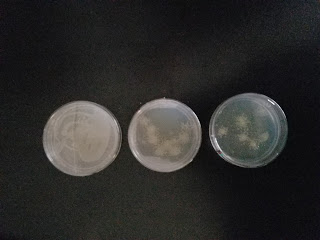
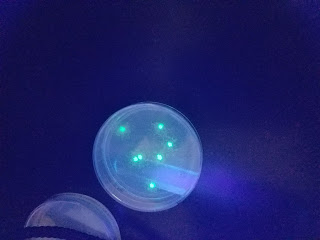
Before I go into the ethics of biotechnology and all its glory, I would like to focus on one of the labs we did as groups in the class. This was called the pGLO lab, and we had a vodcast on it as well. This lab and vodcast showed part of what happens in the recombination of DNA. This is only the adding of foreign DNA, or plasmids, into the bacteria in order to transform, highlight, and reproduce it. This is only part of recombination because it leaves out the other components, such as restrictive enzymes and the insertion of the new bacteria into the organism. It also lacks the gene of interest, or the targeted gene. This recombination of DNA is very important and has helped countless of organisms because of its ability to fix/replace defective DNA.  This lab was very fun and we got to see the growth of bacteria in action. My favorite part of the lab was just realizing that the bacteria was actually bacteria. It is amazing to think that such a small and simple organism could reproduce and pick up plasmids like that. The average e.coli is 0.2um, and the plate had about 1 inch of bacteria, that is a lot of growth in 2 days. Not only that, but such a simple organism has the ability to pick up DNA from its surroundings! That is what I find incredible. The glowing under the UV light was amazing.

The photo above shows the versatility of the e.coli we used for the experiment. This one picture shows the reproduction of bacteria in only 2 days, and its ability to pick up plasmids, which are shown with the bacteria that glows with UV light. 

We then focused on bioethics, which in my opinion is polluted by religion. I am not attacking religion at all, and I know many ethics/morals are based on religion, but I think this world and this field of science would flow much smoother and be more cooperative if religion was not a major factor. I say this because we have seen religion come into many debate, ranging from death penalty to abortion to cloning. Topics such as these have been plaguing the nation and politics for years. Cloning is occurring as we speak to multiple organisms inferior, or as thought by humans, to us like rats, dogs, cats, cows, etc., but there have been proven genetic defects for these clones. This has not stopped us. However, for the same reasons, humans refuse to clone each other. There are many flaws in the ethics of the debate. 

Another lab I would like to point out in the unit is the gel electrophoresis lab. We went over the process of gel electrophoresis lab at many different times, so I will not go over it in detail. Gel electrophoresis is the process of measuring the lengths/sizes of DNA strands by putting them in a gelatin like substance. Then, the gel is connected to power, with the side with DNA samples on the negative side of the power, and the opposite side of the gel with the positive charge. Once turned on, the DNA is attracted to the positive charge, and this causes the strands to move across the gel. The smaller the strand, the farther it moves, and visa versa. I enjoyed this lab because it was different from everything else I had ever done before. Usually, you deal with replicas or sugars/salts. Yes, this contained a sugar as well, but we worked with dye samples from candy, something similar to DNA. I always thought that this was something done only by the professionals, and it gave me a positive feeling about this class. 


This is a time lapsed video showing the first about 7 minutes of the gel electrophoresis in action. Sorry for the constant movement, as I did not have a stand and we were cleaning up at the same time. 

This unit, especially the labs, showed me that I need to work on sensitivity and tolerance. Although these are not stated in my New Years Goals resolutions, the gel electrophoresis lab and the pGLO lab showed this to me. In both labs, I took a leadership role. Everyone participated, but I seemed to lead the group. This was OK with everyone, but things did not always to as planned, as they rarely do. Sometimes a group member would forget to use a sterile/new pipette when adding a foreign substance to the agar, or they would not respond when I asked them to do something. Although I kept it in for the most part, I was angered at their lack of presence and action in the labs. However, after the labs I reminded myself that no one is perfect and even I make mistakes. This shows how I need to work on empathy and how not everyone is perfect. 


Monday, January 30, 2017

pGLO lab Conclusion

Shiv Paul Gupta
pGLO Observations , Data Recording & Analysis
1.
Obtain your team plates.  Observe your set of  “+pGLO” plates under room light and with UV light.  Record numbers of colonies and color of colonies. Fill in the table below.
Plate
Number of Colonies
Color of colonies under room light
Color of colonies under   UV light
- pGLO LB


- pGLO LB/amp
Unclear amount, bacteria grew in different shapes and sizes, and mixed together. No clear colonies
A light brown/beige, color of diluted agar
+ pGLO LB/amp
8 colonies with the same shape, of a sun
A light brown/beige, color of diluted agar
+ pGLO LB/amp/ara
7 colonies that lit up with ray like branches. Similar to a sun figure.
A light brown/beige, color of diluted agar
Fluorescent green
2.
What two new traits do your transformed bacteria have?
The first is the distinct growth pattern or formation of the bacteria. They grow in a starfish/sun pattern where there is one main body of bacteria, and they more bacteria branches out from the main body.
The second new trait is the fact that the main body of bacteria glows a fluorescent green due to the GFP fluorescent protein and the arabinose trigger.

3.
Estimate how many bacteria were in the 100 uL of bacteria that you spread on each plate. Explain your logic.
Considering the miniscule size of bacteria, I can hypothesize that there are about 100,000,000,000 bacteria in 100 ul. I got this number because the average bacterium is about 0.2um, and doing the rough conversion of ul to um3I got my answer.


4.
What is the role of arabinose in the plates?
Arabinose is used as a trigger for the plasmid. As we learned in the vodcast, the plasmids have two proteins. One is GFP, extracted from jellyfish. This protein is used to make the bacteria that picked up the plasmid glow. However, the GFP cannot do this on its own. It needs a trigger, which is where the arabinose sugar comes into play. It is necessary for the plasmid to actually glow.
5.
List and briefly explain three current uses for GFP (green fluorescent protein) in research or applied science.
One application for GFP is its use for marking gene expression. Due to the lack of need for exogenous substrates and cofactors for this fluorescence, GFP expression can be used to monitor gene expression and protein localization in living organisms.
Another application for GFP is like this lab, where it makes it easier to locate and differentiate bacteria from one another.
A third use for GFP is to light up parts of the body for medical or scientific study. They can be used to highlight synapses in the body. This can make it easier to see and study.  

6.
Give an example of another application of genetic engineering.
One major use of genetic engineering, or genetic modification, is its ability to create and mass produce drugs and medicines such as insulin and growth hormones. The genetic engineering has lead to growth hormones that have treated dwarfism and other minor genetic defects.

Thursday, January 19, 2017

Candy Gel Electrophoresis Lab Conclusion

When we analyzed the results of the gel, there were two dyes that had a different result than that of the reference dyes. The first dye that differentiated from the reference dyes came from Eng's candies, which were purple skittles. The original dye that came off the skittles was purple. However, at the end of the actual electrophoresis lab, the dye had separated into the same purple dye, but under the purple was a dark red dye. This was the exact color dye of the red reference dye. The red experimental dye that came out of the purple dye also traveled the same amount as the red reference dye. The photo below faintly shows the color separation in the purple experimental dye. The purple is five dyes from the left.
The second case of a differentiating dye came from my candies, the green Mike & Ike's. The green dye separated into a yellow dye that was identical to the yellow reference dye, and a blue dye that was identical to the blue reference dye. There was a significant difference between the distance traveled of the two dyes, but there were the same distances as the identical reference dyes. The photo above also shows this separation. It is the farthest right in the photo. 

The Fast Green FCF dye would travel similarly to the Blue 1 reference dye because their structure is virtually the same. The only difference is the molecules that make up the dyes. Citrus red 2 would travel a similar distance to both Yellow 6 and Red 40. This is not only because of the structure, but also because of the molecules that make the dyes up. Citrus red 2 is made up of OH, N, and O, while the two reference dyes are made up of HO, N, SO3, and O3S. There are only small differences in the makeup. Neither Carminic acid nor Betanin are similar to the reference dyes. 

Dog food manufacturers put artificial food dyes in the dog food to attract the owners of the dogs. Dogs that eat the food do not care about the color of the food they eat, considering the fact that they are color blind. However, their owners are conscious about what their beloved pets eat. It is just like buying food for their child, which is why they go for the most attractive foods and want what looks best for their pets.

Instead of keeping a record of our weekly intake, we decided to monitor the artificial dyes in popular foods. For example, fruit flavored, whole grain cereals considered healthy often had a mix of Blue 1 and Red 40. Specifically, fruit flavored Cheerios contains Red 40, Blue 1, and Yellow 6. It was also recently discovered that 19 of the most popular yogurt brands made their yogurt with Red 40. 

The two factors that most affect the distance traveled by the dyes are the charge and the length/size of the dye. The charge of the dye affects the distance because gel electrophoresis works on the DNA's electricity. The DNA is attracted to positive charges, which means that charge of the DNA/dye tested matters. The size/length of the dye matters because the smaller the strand, the faster/farther it travels. 

Electricity is the force that helps more the dyes through the gel. The dye is attracted to the positive charge at the other end of the gel .

The electricity component also causes the molecules to separate by size. This is because the dyes move across the gel plane with the positive charge. However, the dyes move a certain distance in a certain amount of time. The size affects the distance traveled because the larger the dye, the longer it takes to get from one place to another. It is like a small Porsche racing against a large 18-wheeler. The smaller vehicle will win because it is smaller and there is less mass to move from the start to the finish. 

Size corresponds to weight. Mostly, the larger something is, the heavier it is. Going by the logic stated in the previous paragraph, that the smaller/lighter the object the farther it moves, the fewer daltons a DNA strand weighs, the farther it will travel. The DNA that weighs 600 daltons will travel the farthest, while the 5000 dalton DNA will travel the shortest distance. Everything else falls in between.  


Tuesday, January 10, 2017

2017 New Year's SMART Goals

2016 was one of my best years yet. Not just because of grade, but also because of obstacles I have overcome from family, to friends, to school. An example of this was when my sister Shazia went to college. The day she left, everyone was excited for her but sad at the same time. However, I was just excited. I did not think I would miss her very much. As time went on with an empty, lonely bedroom in the house, I began to feel it. I would turn the corner of the staircase to her room and look inside, intending to annoy you, but then I would realize nobody was there. It was only after she left that I realized how much I interacted with her and missed her. When she came home for winter break, I could not spend enough time with her. She is an amazing sister.

Another example of family occurred over December break. Maya and I don't usually get along very well, and we would constantly get into fights over the littlest things. However, as if a whole other person took control of her body, Maya was one of the best older sisters anyone could ask for. She was there for me when I was sick, when I injured my arm, and just to hang out. It was crazy how all of a sudden she had changed. I had tried to mend our relationship many times before, but I was not great at being "the bigger man".

These changes and accomplishments last year lead to a new found determination to improve myself. One thing I noticed in this class especially is my lack of determination and punctuality in the class. I did not take this class seriously at first because I did not like the teaching method of lectures at home. When there was a blogger post or a vodcast due, I would usually do them at home, but then sometimes just blow it of because I was tired. Considering the fact the I play a sport now, I have a free fourth period. However, my 2017 new year goal is to do the homework at home, and stop procrastinating. This is more of a mental goal. One thing I am going to do is put my phone away during the vodcast. That is a major distraction for me. Another thing I am going to do is set a specific time for myself daily, or every other day, on when to do biology. Although I should have done these things in the first place, I did not, but I will do them now.

My second new years goal will be to get to school on time everyday for the rest of high school. I would usually show up to school about 2-5 minutes late about 2-3 times a week, which is surprising, considering the fact that I was punctual in middle school. The main reasons for my tardiness are lack of sleep and an increase in traffic to get to SHS. My plan this year is to finish my homework by 9-9:30pm latest (putting away all distractions such as my phone will help), and to be more productive while getting ready in the mornings. This will not only give me more energy, but then I will be able to improve in school as a whole.


Friday, December 16, 2016

Unit 5 Reflection

This unit was focused on the central dogma. This is the process of changing DNA to RNA to Proteins, and eventually to an organism. The reason for this process is to create the phenotypes of organisms. Proteins make up phenotypes. The Central Dogma states that information is transferred from DNA to RNA to Proteins, and eventually to Organisms (phenotypes). Transcription is the process where DNA unzips, and RNA is made to match the spare nucleotides to make messenger RNA. The mRNA them travels out of the nucleus and over to the ribosomes, where they will be read. Once they are read, they are separated into sets of 3 amino acids, or codons. These are protein sequences that make up our phenotypes.

Although the process sounds simple enough, many things can change, either cause harmless genetic variations, or make things go horribly wrong. These are called mutations. There are many different types of mutations. The first is called substitution. This is the least harmful mutation. Substitution is when one base is accidentally switched with another base. This causes slight variations in the protein codes. The most harmful mutation is deletion. Deletion is the taking away of necessary bases from the sequence. This can lead to serious damage and loss of code.

One of my greatest strengths was the ease in which I could transcribe and translate DNA to RNA, and then convert into codons. Because of this, I really enjoyed my Protein Synthesis Lab, and was done with it rather quickly. One of my greatest weaknesses however, was my lack of ability to understand gene regulation. I don't understand how the physical transfer of information works, which leads me into my unanswered questions.

Like I said, I don't fully understand how the physical transfer of information works, nor do I understand gene regulation in full. I am also not sure about how different genes all fit into 4 different nitrogen bases.

I think I grew the most in this unit because I had to stop and slow down to make sure I understood everything to the best of my ability. This was not a small/simple unit, but rather one I had to focus on. I did not just do the vodcasts for the credit, but I did it out of my eagerness to learn. I learned to do things for my own personal gain/incentive. I did not do it for the grade.


Wednesday, December 14, 2016

Protein Synthesis Lab

   Protein Synthesis Lab

To make a protein, you must start with DNA and RNA. We start with DNA being copied by an enzyme in the nucleus. The copy that is produced in the RNA. RNA then leaves the nucleus and goes to the ribosomes. The RNA bonds with a ribosome to make proteins. The ribosome reads the RNA strand in a sequence of 3 amino acids at a time, which is called a codon.After the chain is read, the RNA is balled and condensed up to form a protein. 

https://upload.wikimedia.org/wikipedia/commons/thumb/5/50/Molbio-Header.svg/2000px-Molbio-Header.svg.png

The changing of bases in DNA is substitution. This is one type of Point Mutation. Substitution was almost completely harmless, We know this because the codons and the codon abbreviations did not change at all from the original transcription and translation of the DNA. Our next mutation was insertion, or the addition of an unnecessary base. This had obvious effects, as 5 amino acid sequences were changed, and so was the length of the code itself. Our last mutation was deletion, which is the subtraction of a necessary base from the DNA code. The effects of deletion from this code were catostrophic, as the sequence itself was shortened dramatically, and the sequences themselves were changed. Over half of the code was changed. Substitution was the least harmful of all mutations, while deletion was the most harmful.


https://www.researchgate.net/profile/Axel_Visel/publication/26800032/figure/fig2/AS:282055054249989@1444258573084/Figure-2-Consequences-of-deletion-and-mutation-of-the-limb-enhancer-of-sonic-hedgehoga.png

Considering the fact that deletion causes the most harm out of the 3 tested mutations, I chose deletion, but instead put the deleted base at the beginning of the code. The effects were even more harmful than when the deletion occured in the middle of the code. When the first base was deleted, the amino acid sequences stopped after the start codon. There was no continuation of the code. Where the mutation occurs greatly affects the mutation and its effect on the organism. For example, the first deletion occurred in middle of code, and this lead to a change and a shortening of code. However, the second deletion occurred at the very start of the code, which lead to only one, the start, amino acid sequence to form.


This lab, although not as visual as our other ones, showed the possible effects of mutations, both harmless and harmful, and also negative. A mutation could affect our life because it would affect the proteins that make us up. They do this by adding, subtracting, or switching around the bases in the DNA code. This leads to a wrong genetic code, which will then lead to the ribosome that connects to the RNA reading the codons wrong and ruining the proteins. This would then ruin the organism, or even kill it. Deletion syndrome, or formally known as DiGeorge Syndrome, is a deletion mutation that occurs due to the deletion of a small chunk of chromosome 22. This syndrome mostly affects children from birth to the age of two years old. Deletion syndrome leads to poor development of body parts and systems, and will later lead to such things as heart defects, poor immune system function, cleft plates, and low amounts of calcium in the blood. The disease is rather rare, and less than 200,000 people throughout the world have it. Unfortunately, there is no cure to this disease, and it is a chronic syndrome. Treatment is available, but it is often lifelong, due to its fatality.


https://upload.wikimedia.org/wikipedia/commons/9/9e/22_del_q11.2.png

Monday, December 5, 2016

DNA Extraction Lab Conclusion


In this lab, we asked the question, "How can DNA be separated from cheek cells in order to study it?" This lab was different from the rest, however. Instead of following the steps of the lab and getting the end result, we actually had to organize the procedure into the correct steps in order to achieve the desired results. We first scraped cheek cells from the inside of our cheeks. Then, we swished them around in a small amount of Gatorade, and spit the solution into a cup. After that, we poured the solution into a test tube and mixed it in with a small amount of salt, and about 9 drops of both Dawn Dish Soap and Pineapple Juice. The salt facilitated the precipitation, which allowed the ends of the DNA to move closer together. The dish soap was used to lyse the solution, or disintegrate the cell wall/membrane and get to the DNA. Finally, the Pineapple Juice acted as the enzyme which helped break down any remaining proteins, called histones, which the DNA molecule wraps itself around.  After this, we shook the test tube containing the newly made solution, and waited for about 5 minutes for the solution to mix and settle. After the 5 minutes, we added cold isopropanol alcohol in such a way that the Gatorade solution and the alcohol don't mix. This would lead to an unwanted result. The alcohol itself is non polar, while the DNA is polar, which leads to the DNA falling out or separating at the interface of the two solutions. We found that by following the procedure stated above as closely as possible, and by being especially careful while handling such solutions as the alcohol or Gatorade solution with everything mixed in can help attain the desired results.
This photo shows the procedure we organized
At first when we added the salt, soap, and juice to the Gatorade solution in the test tube and gently mixed it, the solution was a rather still translucent red. You could begin to see the cheek cells inside the solution. They looked like small white specks connected/bunched together to make thin, fibrous strands. However, after we added the alcohol, we could start to see a haze in between the two solutions. This was the slow precipitation of the DNA extraction. Soon after the white haze had formed, small chunks of DNA started to separate and become visible in the alcohol solution.

 This is the Gatorade solution and the alcohol in the test tube and the start of the precipitation process.


While our hypothesis was supported by our data, there could have been errors in my test tube and experiment especially because of the amount of solution that ended up in my test tube. From my table group's results and my own results, I can conclude that the amount of the Gatorade solution, and the alcohol which had to have a similar result, does affect the time the precipitation process takes. One table partner had used very little of both solutions, a little less than one third, and this lead to a large amount of DNA extracted from the solution in a short amount of time. However, I created an end solution that filled the test tube. This lead to an extremely slow precipitation process and the small amount of DNA extracted from the process. Another possible error could be the soap bubbles created due to the speed and intesity of the shaking of the solution before we added the alcohol. The procedure specifically states shake the test tube in such a way that minimized the creation of soap bubbles. However, no matter how we shook the test tube, bubble always formed. I cannot say that this affected our results in a negative or positive way because we all tested the tube with the same procedure of shaking the tube. Due to these errors, in future experiments I would suggest the procedure be changed for two of the steps. First, it would minimize the risk of creating soap bubbles by using a device to stir the solution gently instead of shaking it. This could lead to more accurate results. Another step that would be more helpful to change would be the amount of Gatorade solution used in the test tube. I would suggest that the procedure only states 1/3 of the test tube should be filled up in order to speed up the process and create more DNA extraction. 
 This picture shows the soap bubbles formed from the shaking of the solution. 

This lab was done to demonstrate not only the isolation process of DNA, but also the functions and characteristics of DNA, homogenization, lysis, and precipitation. From this lab, I learned more about the characteristics of DNA, like the fact that it is polar. I also learned the functions of many factors used to isolate DNA, which helps me understand how scientists can isolate DNA and study it. It also helps me understand the concept of DNA itself.